Publication select ▼

FARMINGTON HILLS — After nearly two years of back and forth between city officials and developers, the Farmington Hills City Council approved a planned unit development located at 13 Mile Road west of Middlebelt Road. The decision was made at the council’s Jan. 12 meeting amid community opposition.
Schafer Development resubmitted its request for The Tabernacle and Mulberry Park project that was initially denied at the council meeting Aug. 11, 2025. The Planning Commission qualified the project as a planned unit development in April 2024, said Charmaine Kettler-Schmult, director of planning and community development for the city.
The developers have met with the city 10 times now — seven times before the City Council and three times before the Planning Commission, according to Councilman William Dwyer.
The council voted 3-4 to deny the motion to be approved Jan. 12. There were three “yes” votes to deny, with four “no” votes not to deny. The motion failed, and the planned unit development was finally approved.
Project overview
The Tabernacle homes are one-story ranch rental units for residents 55 years old and older. Rates will start around $2,300 per month, with possible adjustments for the market at the time, according to Aaron Schafer, one of developers with Schafer Development.
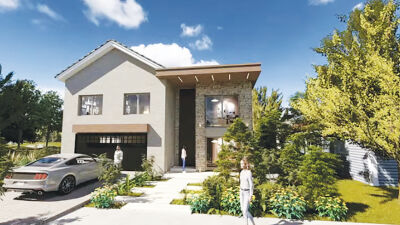
Mulberry Park units are mostly two-story townhomes, with some one-story duplex ranches. They are available for sale, with the price of townhomes starting at the low to mid $400,000s. Duplex ranches are slated to cost more, according to the developers.
The development is described as “multigenerational living,” with ranch housing for seniors and townhomes designed for younger buyers who want new, maintenance-free homes.
“This project will deliver much needed, new, and attainable housing to the community, in both rental and for sale housing,” he said.
Density concerns led the council to previously reject the development. Density is the number of units per parcel of land.
Last August, 63 units were proposed on the 12-acre property. In addition, the rear setbacks and buffers separating the units from the neighboring subdivision needed to be increased, and a zoning change was requested from its current zoning of RA-1 to an RC-1 zoning, which allows for increased density. Setbacks are the minimum distance required from the structure and property line, street or other specified features as determined by zoning ordinances and building codes.
RA-1 and RC-1 are residential zoning classifications. RA-1 is low density, where many of the homes are on lots that range from a half-acre to 2 acres. RC-1 typically refers to cluster zoning, which allows for higher density and smaller lot sizes than traditional residential communities.
Schafer presented the following changes: The number of units were reduced to 59 from the 63 units proposed in August 2025 and 76 units initially planned in January 2025.
Mulberry Park will now have a total of 30 units — 22 two-story townhouses and eight single-story duplex ranches. The eight ranches are also for sale and have no age restrictions.
These units were originally proposed as townhouses but were changed to ranches so as not to obstruct the view of the neighbors to the south in Holly Hill Farms, a subdivision directly behind the property. The other 29 units are ranches in The Tabernacle.
To move forward, the zoning would need to be changed from RA-1 to RC-1. This would be allowed through flex zoning, which calculates the density of a property by total rooms as opposed to units. The total number of rooms now is 207, as opposed to the 221 rooms proposed in August 2025. This lowers the density by 22.4% from the RA-1 zoning, according to Schafer.
Open space within the development was also a concern, and was increased from 0.4% to 0.74% acres in the middle of the development. This is a 54.82% increase compared to what was shown in August 2025. In addition, a 100-foot setback was added to the homes in the rear to provide privacy and separation for their neighbors in the subdivision to the south.
“It is imperative to know that the master plan stresses the need for missing middle housing, especially much needed senior housing,” Schafer said. “Our project aims to meet these needs.”
This project allows for multiple generations to live together harmoniously, he continued. More than 60% of the development is what he called “age-friendly housing.”
The Tabernacle will be part of Baptist Manor, a senior community that offers services such as transportation to the doctor, cleanup and laundry services. The Tabernacle and Mulberry Park developments are independent living communities, but if the services provided by Baptist Manor are wanted, residents can contact them directly.
Some of the older units at Baptist Manor will have to be torn down along 13 Mile Road to enhance the visual streetscape and add beauty to the new development. For the displaced seniors, The Tabernacle will have units available to the seniors, but there may be a difference in rent.
The new developments are not deemed to be affordable housing.
“Baptist Manor offers some of the most affordable rents in the market,” Schafer said. “But do not misconstrue this development as being affordable like that. It is all to be market rate attainable housing.”
Community concerns
Community members have spoken against the project from the beginning and continued to do so at the Jan. 12 meeting.
None who spoke were in favor of the development. Even with the changes, the project was still too dense and not in keeping with the area, they said. Many claimed the project would increase traffic jams, flooding risks, and decrease their property values.
“When the property was purchased… they knew it was (zoned for) RA-1. I feel like we’re being victims of a bait and switch,” said Farmington Hills resident Michele Nagoda. “We’ve lived there for a long time. Now it’s variable (flex), but variable doesn’t mean you just keep stuffing homes in.”
Others addressed the flooding and how this would reduce their property values.
Holly Hill Farms, Pebble Creek and West Acres Franklin Village are established subdivisions that surround the new development. Many residents there were concerned that removing hundreds of trees would increase flooding.
The developers said the trees removed would be replaced by even more trees.
“You are still not considering the residents that are on the sides of this development,” Craig LaPointe said. “I can speak from experience that flooding is my major concern. Water does not run uphill. You will not get the water in the back to run uphill to that retention pond.”
According to the developers, there will be a retention pond on the new development that will have the water capacity to hold enough water from a “100-year storm,” which is a storm that is so intense that its likelihood of happening is once in 100 years.
“I have serious flooding in my backyard,” LaPointe said. “If this was your own house and you lived where I live. I’m sure none of you would want this going on behind you.”
At the Jan. 12 meeting, Councilman Michael Bridges proposed a motion to deny the developer’s plan again. He said the development is out of character for the neighborhood and the buffer is inadequate. Although flex zoning was adopted by the City Council, he said it has never been implemented. According to the traffic study submitted by the applicant, vehicle delays are also expected. In the end, council members Bridges, Valerie Knol and Charlie Starkman voted “yes” to deny the motion.
“For me the issue has always been density,” Knol said. “I don’t feel the density has been adequately reduced.”
Council members Dwyer, Jon Aldred, Jackie Boleware, and Mayor Theresa Rich voted “no” on the denial and pushed to move forward with the development, provided the changes presented by the developer would be implemented.
This was a departure from the Aug.11 meeting, where council voted 6-1 to deny the development. Dwyer was the only one voting “no” on the denial, which meant he wanted the development to move forward.
“My position has not wavered,” Dwyer said.
Aldred, who previously had concerns with the setback and buffering, was now in support of the development.
“If there is sufficient buffering to the south, and the developers do what I believe they are saying they will do … then I could see how this would be a benefit to the community,” he said.
You May Also Be Interested In