Publication select ▼
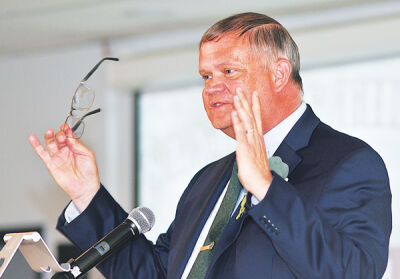
Kyle Degiulio, manager of economic development policy at Amazon, demonstrates how the drone carries the packages.
Photo by Patricia O’Blenes
OAKLAND COUNTY — Amazon will soon begin offering deliveries by drone, flying packages straight to the homes of customers who live within an 8-mile radius of the company’s Hazel Park distribution center at the corner of 10 Mile and Dequindre roads.
The shipping option, dubbed Prime Air, will only be available for certain goods. It is being marketed as a convenient way to get last-minute items without a trip to the store. But some are concerned about the safety of flying packages over traffic and homes, the noise it might create and whether it violates the privacy of homeowners.
To address any concerns, Amazon held a public event Nov. 20 at the Hazel Park Community Center, 620 W. Woodward Heights Blvd. The event allowed guests to see the MK30 drone up close, learn about how its one-hour delivery service works, and meet the team members who operate it.
Gordy Dalziel lives in Royal Oak, which is within range of the drones. Dalziel described how he had previously seen an Amazon drone making a delivery in Berkley, in what he believes was a test run.
“It was pretty noisy, which is how we noticed it, but it was fast — it took maybe five minutes once we saw it to drop off its package, and then it was gone. It hovered for a moment and took off,” he said. “When you see how it cuts over the houses and it’s gone so quickly, you can see the efficiency of not being on the roads making those deliveries.”
After the event in Hazel Park, he said he still has some concerns, such as whether the drones will work in all weather conditions, or whether they could violate people’s privacy.
“If you want it delivered in your backyard, to avoid porch pirates, (the drone) might come in with the camera when you’re not expecting it, and you might be doing something where it invades your privacy,” Dalziel said. “So, I can see pluses and minuses. There might be some kinks for them to work out.”
According to Sharyn Ghacham, a representative for Amazon, customers will see whether a product is eligible for drone delivery upon checkout. Customers select and confirm a preferred delivery spot at their address, such as in a driveway or yard. Once it arrives, the drone descends to about 13 feet from the ground — low enough to safely deliver the item. It also scans the ground to make sure it’s clear of people, pets or cars before dropping the item.
Prime Air delivers packages that weigh less than 5 pounds and fit within the drone’s delivery box, which measures 15-by-8-by-5 inches. Eligible items include household products, beauty products, office supplies, some electronics and more. The service promises delivery within 60 minutes of the order being placed. The shipping cost is $4.99 per drone delivery for Prime members and $9.99 per drone for non-Prime members.
“You could wake up in the morning, realize you’re out of coffee, and if you don’t feel like leaving your house to run to the store, this drone comes to you and arrives in your backyard with the coffee like 20 minutes later,” Ghacham said.
Upon first hearing about the service, Huntington Woods City Councilman Jules Olsman said his feelings on the drones were “very complicated” and he wasn’t sure how much, if any, local enforcement the city could have.
“I’m sure that they’ll argue that it’s less dangerous than a delivery truck, less intrusive than a delivery truck … that the delivery of packages is going to occur whether it’s by truck or by drone,” he said. “I guess it’s no surprise that this sort of service is coming about, and it’s not a surprise that a company the size of Amazon is doing it, and they’ve got the resources to get it approved and they’ve got the resources to, I suppose, stand behind it.”
“I’m sure they’re going to argue it’s more environmentally responsible. You know, it doesn’t bother anybody. It comes and goes. You wouldn’t notice that any — it’s not a commercial aircraft,” Olsman continued. “It doesn’t make any noise. … They said it’s 40% less noisy than the original models were. Well, I don’t know what that means. I don’t know what the decibel levels are. I can see it being … intimidating to animals, maybe.”
Olsman is interested to see how other municipalities are going to react to the drone program.
“I’m hearing about it for the first time now,” he said. “I would have a lot of questions and I surely wouldn’t vote to approve anything without a thorough, independent survey on our part, or at least by other municipalities of what the safety risks and concerns are.”
It was exciting for Pleasant Ridge Mayor Bret Scott to hear about a new service coming to the area.
“I’ve not had an opportunity to talk to Amazon directly about it to know how it impacts Pleasant Ridge residents and which residents would be able to take advantage of the service,” he said. “So, there’s some homework that I have to do yet to understand all of that.”
Scott thinks anything that can provide better service from Amazon is good but understands any concerns people might have about the drones, which he hopes to get more insight on from the company.
Scott also wondered what, if any, are the technical challenges of the drones flying into a city like Pleasant Ridge, such as weather conditions and the number of trees in town.
“There are also issues around tree coverage and things that might rule out a number of homes in Pleasant Ridge,” he said. “I’m curious to speak with them about all the things that might allow for an address to have service and not have service, but also understand how people can opt in or out.”
After getting more information on Prime Air through an online informational meeting, Ferndale Mayor Raylon Leaks-May thinks it will be a worthwhile service
“There were some people online that were concerned about what these cameras and the drones would be recording,” she said. “It sounds like based on what I heard that they’ll strictly be covering the deliveries and, of course, assessing the area as far as landing and safety.”
Leaks-May was uncomfortable when she first heard about the drone program, likening it to something out of a movie, and had concerns about potential privacy issues. She now thinks it can be a resource of convenience.
“With technology, I guess anything can go wrong,” she said “I was uncomfortable at first because I didn’t know how that would actually work. I mean, you just drop a package. Where are you going to drop it? Or what about the weather? How do these things work? It’s just something I didn’t know much about. But apparently they have navigated all of that and I’d like to see what happens.”
The drone itself has received approval from the Federal Aviation Administration and features advanced technology for detecting and avoiding obstacles. Ghacham also said that the drone is “quieter than a vacuum (cleaner) upon delivery,” faster than traditional delivery and that it helps reduce road congestion.
The program also has a system in place for detecting what it calls “high-frequency buyers,” changing up routes between deliveries so that the drones don’t always fly past the same homes.
At press time, a start date for the delivery service had not been finalized.