Publication select ▼
In his State of the Cities address at Farmington High School March 6, Farmington Mayor Joe LaRussa said his city is enjoying strong momentum thanks to new investment and partnerships.
Photo provided by Farmington

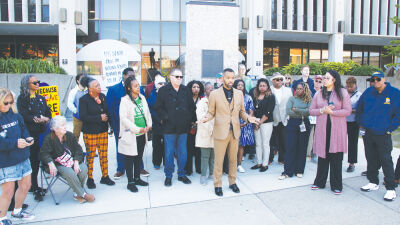
The Southeast Michigan Council of Governments presented the city of Farmington with a check for nearly $500,000 at the event. The funding will pay for new sidewalks and crosswalk improvements throughout the city.
Photo provided by SEMCOG

FARMINGTON — Farmington Mayor Joe LaRussa wasted no time declaring the upward trajectory of his city during his State of the Cities address March 6.
“I’m happy to inform you that the state of our city is strong,” he said.
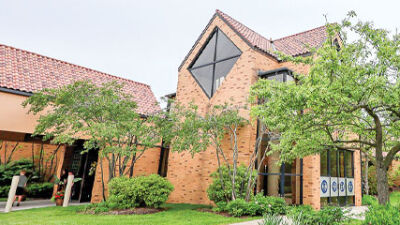
The event was held at Farmington High School, 32000 Shiawassee Street in Farmington, and presented by the Greater Farmington Area Chamber of Commerce.
Joining LaRussa were Farmington Hills Mayor Theresa Rich, Oakland Community College Chancellor Peter Provenzano Jr., Farmington Public Schools Superintendent Kelly Coffin, and Kristine Donahue, president of Corewell Health Farmington Hills.
LaRussa said Farmington has shown “effectiveness” and “momentum,” with the city courting investment while carefully managing its finances. Along the way, it has enhanced historical landmarks, forged new partnerships and developed upcoming events.
LaRussa recognized his council and its commitment to “the Farmington Way.” In addition to LaRussa, the five-member council includes Mayor Pro Tem Johnna Balk and council members Steve Schneemann, Kevin Parkins and Maria Taylor, who together have more than 30 years of government experience.
He commended the leadership of City Manager David Murphy and Farmington Public Safety Director Robert Houhanisin, citing low crime rates and quick response times.
He also praised the work of Public Works Director Josh Leach for bringing a new salt dome to town and keeping the roads clear during one of the snowiest winters in recent history.
LaRussa also spoke to new investment.
“Tonight, I’m pleased to announce that Farmington will receive $1 million in congressionally directed spending to support upgrades and refurbishments to our Nine Mile pumping station, thanks to the support of Congresswoman Haley Stevens,” LaRussa said.
State funding also resulted in a new fire engine and drone for Farmington Public Safety. The drone has thermal imagery and infrared camera capability. According to the mayor, the drone will help find missing people, monitor parades and more.
The mayor acknowledged the Transportation Alternatives Program, by the Southeast Michigan Council of Governments, which awarded Farmington nearly $500,000 to install new sidewalks on the west side of Drake Road from Freedom Road to Drake Park, in addition to adding pedestrian safety upgrades to key intersections throughout the city.
“This is a great project, which will improve safety for everyone and improve accessibility,” said Gwen Markham, an Oakland County commissioner and SEMCOG chair. “Our Regional Review Committee, which approved these funds, really likes to support projects like this.”
SEMCOG annually facilitates about $1 billion in federal transportation funding distribution to local communities, LaRussa said.
“We all appreciate having supporters in both Washington and Lansing who champion these initiatives and help to bring resources to our region,” said Amy O’Leary, the executive director of SEMCOG. “This project demonstrates how regional partnerships can deliver targeted improvements that improve accessibility and create safer, more connected communities throughout the region.”
The downtown Farmington area saw nine of the city’s 11 new businesses in the past year. The Downtown Development Authority made a $226,000 public investment that was matched by $8.4 million in private investment, LaRussa said.
“That’s a 37-times multiplier,” said the mayor. “It speaks directly to the attractiveness of our safe, walkable and cool spaces. And for the second year in a row, (our) downtown has been named a semifinalist for the Great American Main Street Award, a national contest that has brought a lot of notoriety and attention to our city.”
During the past year, Meaghan Bachman, Farmington’s clerk, consolidated voting precincts in the city. The mayor said voters are using early voting and absentee voting more often, and as a result, voting at the polls has decreased. For the 2026 voting cycle, the number of precincts will be reduced from five to three precincts spanning two locations. Voters registered in precinct No. 1 can vote at City Hall. Voters in precincts No. 2 and No. 3 vote at Farmington High School.
The mayor said the changes save the city about $35,000 in administration costs and help meet new mandates for voting equipment. In addition, Jaime Pohlman, the city’s treasurer and director of finance, saved the city a 72% increase in assessing costs.
Efforts were also made in solving the housing shortage, a challenge facing the entire state.
“At this time last year, we were anticipating the construction of our newest housing project, Hillside Townes by Robertson Brothers. Today, the majority of new housing is up, units have been sold, and we have our first occupants at Hillside Townes enjoying their proximity to Downtown Farmington,” LaRussa said.
This development revamped Thomas and School streets, while updating the water and sewer systems. In addition, new streets were installed, and new sidewalks were built where none previously existed, the mayor said.
The city continues to navigate proposed state legislation that would allow the state to mandate zoning rather than local ordinances.
“I ask you all if the right answer for our two cities is to allow local zoning to be overruled by state mandate,” LaRussa said. “I believe that partnership is a better strategy than preemption, and an alternative legislative solution was recently introduced by state Reps. (Samantha) Steckloff (D-Farmington Hills) and (Mark) Tisdel (R-Rochester), which Farmington’s representatives — (Jason) Hoskins and (Kelly) Breen — have both co-sponsored.”
According to LaRussa, the alternative plan introduced by the legislators provide incentives for zoning reforms requested by developers. It provides money for covering financial gaps in housing developments, and allows for deed restrictions to remain owner occupied, rather than investor owned.
“Please, tell your friends to call their state legislator, and tell them to choose partnership over preemption, to leave local control of land use alone, and help us solve the housing shortage,” La Russa said.
You May Also Be Interested In