Publication select ▼

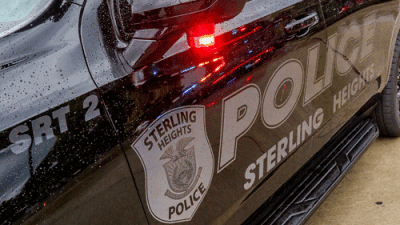
STERLING HEIGHTS — Despite one councilman’s objection, the Sterling Heights City Council voted to approve the purchase of more Flock Safety cameras.
At its Aug. 6 meeting, the City Council voted to approve the purchase of six additional Flock cameras designed to read license plates and note vehicle descriptions, to be installed throughout the city.
Sterling Heights Chief of Police Andrew Satterfield said the cameras are an outstanding tool, and a city the size of Sterling Heights should have more cameras.
“Shelby Township actually just got approved for 50 cameras,” he said. “I say it’s a great tool. We’ve had some great success stories.
With the additional six cameras, the city would have 28.
Satterfield cited a recent example where, during a reported assault, using just the vehicle description, investigators were able to identify the suspects and have them in custody “literally within hours,” he said.
“We wouldn’t have had this without this tool,” he said.
Satterfield also said the department had safeguards in place to make sure the cameras weren’t misused — officers and dispatchers can only access the cameras after going through training and for legitimate purposes, he said. The footage is also purged after 30 days unless being used for investigative purposes, and it’s never sold or transferred to a third party.
Mayor Pro Tem Liz Sierawski said she was OK with the purchase of the cameras, as long as there were safeguards in place to prevent it from being misused.
“I know it’s a wonderful investigative tool, and as long as we do have safeguards in place to prevent it from being misused, and if it is misused, I know that there are repercussions for whomever does,” she said.
Councilwoman Maria Schmidt also agreed that the cameras are a valuable tool for police, and she said she would be voting to support the purchase of additional cameras.
“I think this is an amazing tool that we have, and I know since we’ve gotten the Flock cameras, I’ve heard that it has helped catch a lot of undesirable people that were in our city, and that’s what this is all about,” she said.
Contradicting the support from the rest of the City Council was Michael Radtke, who said he was concerned that the department wanted additional cameras.
“I’m not going to be voting for this. It’s an increase in this real estate,” he said. “It’s shocking to me when our police chief says, ‘I want 50 cameras. I want 100. I want 200. I want 5,000. I want a camera on everyone’s house.’”
Radtke said it’s an increase in the surveillance of residents of the city, and that even though no wrong has been done with the cameras thus far, that doesn’t mean it won’t happen in the future.
“In Russia and China, they use it to disappear people off the street, and we’re just setting up a system so some other government one day could use this against us,” he said.
Radtke also argued that the camera doesn’t just monitor people coming in and out of the city; it monitors the people who are already living there.
“It’s not just the edges of our city that we’re monitoring. It’s the people traversing inside of our city,” he said. “And if you live by one of these cameras over 30 days, it might capture your car 30 times, 60 times, 40 times.”
While Radtke recognized that there were some important uses for the system — such as in a kidnapping — he still wouldn’t be voting for it.
“I think this causes problems. I think it’s a slippery slope. I’m proud to oppose mass surveillance, and I’m going to be voting no,” he said. “And you know what? I’m going to lose this though, like I lost all the rest of them, but I’m going to still stand on principle and vote no, because I don’t think we should be monitoring Americans.”
In the end, the City Council voted to approve the purchase 6-1, with Radtke being the only vote in opposition.
The cameras are expected to cost $19,300 in the first year, funded entirely by federal forfeiture funds.
You May Also Be Interested In