Publication select ▼

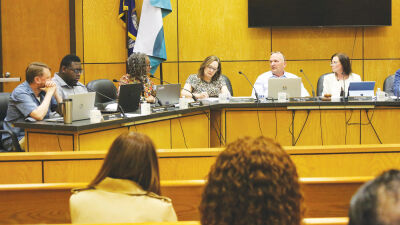
MOUNT CLEMENS — Following a series of public comments at the prior Mount Clemens City Commission meeting, discussions surrounding residential flooding in the city resumed at the meeting on July 21.
During the meeting’s administrative responses segment, City Manager Gregg Shipman said he directed the city’s engineer to study separating storm and sanitary sewers citywide and determine a cost for such a project. The city is also exploring the installation of restricted covers on storm sewers in areas of high flooding.
This did not sit well with residents of Lafayette Street, which was subject to basement floods following heavy storms in mid-June.
Resident Shelby Holderbaum, who was affected by the flooding, used time during the public comment period to seek clarification about Shipman’s statement. Holderbaum said she spoke with Shipman last year about a study that found separating Lafayette’s sewers would not be doable because there is nowhere to send stormwater to from the northwestern corner of the city. Other parts of the city send stormwater to the Clinton River.
“I just want to make sure that we’re not blanketing this by saying we’re going to do an analysis that was already done,” Holderbaum said. “Can we have some transparency and some elaboration on what was done previously and what was found in that analysis and what exactly is being done in this upcoming analysis that you guys are doing?”
What followed was Shipman taking a rare break in meeting procedure to respond and converse with Holderbaum about the analysis. The prior analysis focused on the area of Lafayette and Madison streets. The findings lead to using restrictive access cover plates on drains in the area on a trial basis.
“The problem, like you said, is that when we have these areas and we separate them, there has to be a place to take the water to,” Shipman said. “There isn’t a place (in the studied area) to take the water to and that’s what we’re running into. That’s why we’re trying this restrictive plate route.”
By focusing the upcoming study on the whole city rather than specific parts of it, Shipman said it could be possible to find a way to phase in separated sewers starting with the most problematic areas.
“We have $200 million worth of repairs that we want to do on our water and sewer (infrastructure), but we’ll have a plan, we’ll know what the costs are, and the commission can decide what they want to do at that point,” Shipman said.
With Holderbaum bringing the question back to what could specifically be done for the Lafayette Street — given that the prior study which led to the restrictive flow drain covers appears to have not stopped sewage floods in area homes — Shipman said there was a “remote possibility” of building a detention pond in either Dorothea-Leonore Park or on the city’s water tower property along Madison Avenue as a way of giving the stormwater somewhere to go. Shipman referred to the Dorothea-Leonore Park detention pond as “a reach” and said the water tower site pond would present “a lot of challenges” as well.
“You’re talking about something that would have to go in engineering for probably six months to a year, so what we’re looking at is a bigger picture,” Shipman said. “A bigger picture where maybe we’re running a brand new main through these areas that’s going to cost millions and millions of dollars that, at some point, we could separate and put this water into.”
Another factor Shipman brought up was how storms of higher-than-expected intensity overwhelm infrastructure designed when expected weather was less intense.
“We don’t get two inches of rain in eight hours, we get two inches of rain in 30 minutes, 40 minutes, 60 minutes,” Shipman said. “You’re not alone. Every community around us is having the same problem. Everybody’s got sewers that aren’t separated and we’re all facing the same challenges … 4.2 inches of rain, nobody can fix that. But if this isn’t working, something we can do immediately is go further up that line and put these restrictive cover plates in.”
Shipman urged residents affected by flooding to reach out to the city in order to make them aware of issues, allow them to be tracked and prompt city officials to respond.
Precinct changes
Following the last meeting’s move to rename voting precinct No. 9 to precinct No. 5, commissioners took steps to further align the city’s voting codes to this change. Commissioners approved the first reading of an ordinance to eliminate precinct No. 9’s boundaries and assign them to precinct No. 5. The precinct renaming was made in order to make the city’s precinct numbers sequential.
Commissioners approved changing the polling location for precinct No. 1 from Turner Chapel Church to the Greater Morning Star Church, located at 87 Robertson St. “Recent building problems” at Turner were cited for the change. Affected voters will be notified of the change by mail.
You May Also Be Interested In