Publication select ▼
Parking lot P-35 at Oakland University is being considered as the location for a new data center.
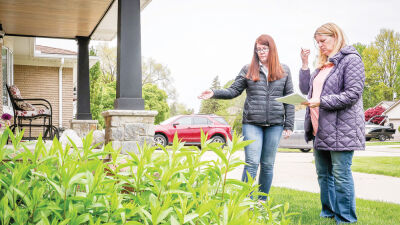
Photo by Erin Sanchez
ROCHESTER HILLS — Over the past few years, Michigan has seen rapid growth in the development of data centers, leaving communities to decide whether to let them in.
Data centers are large-scale buildings that house servers and other infrastructure for modern digital services like streaming, cloud computing and artificial intelligence. Supporters say data centers are economic drivers that can modernize the energy grid, improve internet connectivity, and bring in thousands of temporary jobs and millions in tax revenue, while others argue they invite noise pollution, burden the environment, strain power grids and water supplies, and increase utility bills.
Across the state, land use approval for data centers is done through zoning, which is most commonly approved by cities, townships and villages.
Several Michigan communities, and even some universities, are considering adding new data centers, while others are opting to enact ordinances establishing standards for water usage, noise, height, site planning, and environmental safeguards.
Oakland University is exploring the creation of the AI Institute and Data Center on the P-35 parking lot, just off Pioneer Drive, at the southwest end of campus.
“It is very important for everyone to know that we have not made any decisions regarding the potential housing of a data center at OU and that decision is likely months away,” University Senior Vice President for Finance and Administration Stephen W. Mackey said in a statement.
The university, he said, is in “the initial due diligence,” or “feasibility phase” of exploring the option of housing a data center on campus.
“We have executed an agreement with Fairmount Properties where we can collaboratively assess the feasibility of the project over the next 120 days,” Mackey said in a Feb. 13 statement. “Before any final decision is made, there would be three additional phases prior to a data center becoming a reality.”
A central driver for this project, according to Mackey, is the modernization of campus infrastructure and the optimization of existing academic space.
“A new data center would allow us to move our existing data center from Dodge Hall, which would create more academic laboratory space in that building,” he said in a statement. “This has been a core objective of the project from the beginning — updating our current computing capabilities while simultaneously expanding laboratory space as part of the broader Dodge Hall renovation.”
The university’s website says the potential project introduces a new catalyst for “next-generation research and innovation on campus, expanding the university’s ability to experiment, analyze, and collaborate in ways that open doors for students, elevate research, and connect OU to emerging opportunities across the digital landscape.”
Mackey could not be reached for further comment at press time.
However, some Oakland University students — including the Student Congress, which passed a resolution opposing the center’s development in September — have voiced concerns about that data center’s environmental impact, proximity to both the campus biological preserve and the Native American Heritage Site, and more.
“This isn’t just an OU thing,” said OU Student Body President Marcus Johnson. “It’s becoming a thing (all over). When I had a chance to listen to what students were saying and what some of the faculty was saying, I was hearing a lot of overwhelming concern, especially related to the environmental aspect and the effect it might have on the location chosen and what it’s near.”
Personally, Johnson said he is worried about a new data center deterring future OU students.
“If a lot of students have these concerns now, what’s the likelihood people looking to come to OU are going to have these concerns as well? So then I become concerned about reputational harm to the university. Is it going to deter people from wanting to come here?”
Johnson said he and the others on Student Congress “happen to love the school.”
“We love the school, and we love the campus, and we want to make sure that it remains as environmentally sound as possible,” he said.
The university anticipates the feasibility study to be complete by May and the project to be presented to the Board of Trustees for consideration in June.
If approved, university officials said, the AI Institute and Data Center would be built by a private developer in partnership with OU, with shared use by the university and selected industry partners, and construction could begin as early as fall 2027.
For more information or feedback on the data center project, contact Oakland University at datacenter@oakland.edu.
Rochester Hills passes moratorium on data centers
Rochester Hills recently adopted a temporary moratorium on data centers to allow officials to study potential impacts and draft potential regulations.
On Feb. 23, the Rochester Hills City Council unanimously adopted a 6-month moratorium on data centers, pausing their construction and approval in the city.
Planning and Economic Development Director Sara Roediger said the move gives officials more time to research the impact of the industry.
“Establishing a 180-day, six-month moratorium (will) allow staff time to evaluate what the best practices are in other communities,” Roediger said.
The city, she added, also has a meeting set up with a company that deals with data centers to discuss the noise, impact and other factors.
“We really want to do our due diligence on our side to come up with language that works for Rochester Hills. This just gives us time to safely develop regulations that work for us,” Roediger added.
The city’s zoning ordinance does not currently call out data centers specifically; however, Roediger said that is something the city “is going to look into,” to “ensure that there are safeguards for the community to minimize any potentially negative impacts to the city.”
While Rochester Hills has not received any recent applications or interest in new data centers in the city, she noted that a data center for Henry Home Health, at 2619 Product Drive, has been located in the city, “for decades, with no issue.”
Rochester Hills Mayor Pro-Tem Theresa Mungioli stressed that the moratorium does not mean officials have made a decision on future data center development in the city.
“The moratorium is not saying it’s going to stop data centers. It doesn’t mean we are going to allow data centers. It means we are going to investigate data centers and understand what is the best use if they come to Rochester Hills going forward,” she said.
The moratorium in Rochester Hills does not affect the proposed OU project, Roediger explained, because state-owned universities are exempt from local zoning, and where the data center is proposed is geographically in Auburn Hills.
At press time. The other municipalities in the Rochester Post’s coverage area had not enacted policy with regard to data centers.
In Oakland Township, no data center proposals had been presented to the township at press time, but officials said the Planning Commission reviewed a draft data center ordinance and voted March 3 to forward it to the Board of Trustees for future consideration.
“Rather than have no ordinance in place if a developer approached the township with a proposal, as happened in other communities, the commission felt it best to be ahead of the curve with proper controls and regulations in place,” said Planning Coordinator Donald Mende.
The draft ordinance adds data centers as a special land use in the Research Development district and establishes associated development standards that would be applied under special land use review. A complete copy of the draft ordinance can be found on the township’s website at www.oaklandtwpmi.gov.
Rochester City Manager Nik Banda said the city doesn’t have enough open land to support a data center, so officials have not had to consider associated policy.
“We’re too small,” he said. “We have nowhere that’s big enough for one.”