Publication select ▼

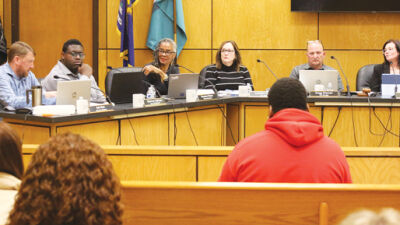
HARRISON TOWNSHIP —The Harrison Township Board of Trustees has approved items related to a special assessment district for the Archer, Lakeshore and Pardee canals.
At its meeting on Feb. 9, the board approved setting public hearing dates. The board also confirmed that the residents received the required number of signatures — more than 51% of those affected — to move forward with the SAD’s creation.
The district would fund the removal of 2-3 feet of sediment and aquatic weeds from the canal. According to the March 9 meeting agenda, the cost was estimated to be $1,333,547.03 or $10,179.75 per lot (spread across 131 lots) and an estimated annual payment of $1,318.32.
Township Clerk Adam Wit said letters were sent out informing residents of the hearing and that notices were also published in local newspapers.
At the meeting, the board held a public hearing for the district, approved resolution No. 3 — which allows the clerk to create a list of who is paying what — and resolution No. 4, which sets the date of the second public hearing.
Wit said before the hearing they received 16 written letters of opposition to the project. Residents who sent in letters could also speak again during the hearing.
Resident Ken Mulder thanked his neighbors and township staff who helped through the process.
“Residents along the Lakeshore, Archer, Pardee canal in intersection with access to Lake St. Clair and the Black Creek started planning this project over three years ago at the end of 2022,” Mulder said.
He said after record high water levels in 2019 and 2020, they knew Lake St. Clair would trend down. There was support for sediment removal in the early 2000s, but it waned as lake levels rose. Mulder said they couldn’t find any evidence of maintenance dredging for a long time.
“Based on research done by the residents we chose to pursue the method of suction dredging rather than mechanical dredging which unfortunately has many more contractors that can provide the service,” Mulder said. “The method of suction dredging allows the removal of sediment up to the seawalls and docks without the possibility of causing structural damage.”
He said that is because they are only removing loose sediment and not changing the depth of the waterway. The residents moved forward with a SAD in 2024 with the aim to complete it in 2025, but the contractor backed out which Mulder thinks is because they underestimated the amount of sediment.
Mulder said the accumulated sediment would lower home values, among other things.
Other residents expressed opposition to the special assessment district.
Resident Molly Zappitell acknowledged the work put into establishing the district, but she said the silt moves around as boats go through the canals.
“It’s really not preventing it not being navigable. It’s just basically allowing more dirt and things to mush around in,” Zappitell said.
She said the concern she has involves her seawall. She said in past contracts there were numbers issues and she also thinks there are liability issues if something goes wrong. She also said she doesn’t know if it will increase the property values by the same amount the district is charging residents.
Christopher Swift is one of the residents who worked on the district for the last three years. He said he spoke to real estate agents who said St. Clair Shores residents experienced a 20% to 30% decline in their home values when their canals became unnavigable.
“They’re definitely a direct impact on the entire community,” Swift said.
He pointed out a house that’s been on the market for six months and said the residents are reportedly having a hard time selling it due to the canal.
Ahmed Hamza said he works in real estate and though he doesn’t live on the canal, he keeps an eye on property values. He backed up Swift’s claim that the canals are causing property values to plummet.
A couple of residents had issues with the idea of dumping any dredged sediment at a nearby playground. They had concerns about possible contaminants in the sediment affecting children and others utilizing the park. Swift said independent labs tested the sediment and those tests came out clean.
Other residents also had issues with the SAD process, the sandbags at the park, the scope of work and more.
Harrison Township Supervisor Kenneth Verkest answered questions at the end of the public hearing. He said the SAD isn’t a township project, but that it is something that the township can facilitate.
“A special assessment can be imposed by the township and (if) 20% of the people affected by it can sign a petition opposing it, it stops,” Verkest said.
He acknowledged this is one of the more controversial projects. He said it is not the job of the township to collect signatures, but if the majority of the residents want the SAD, they are obligated to move forward.
He said in this case, a “simple” majority wants to move forward with the SAD, but some residents don’t want to move forward, and the township has to decide.
“If we are presented with a majority of signatures, but we arbitrarily said, ‘Ah, we’re not going to do it,’ I feel like I’d have to have a pretty good reason not to move forward with that project if a majority of the people in a neighborhood want that project,” Verkest said.
He said the decision lies with the people who circulated the petition and that the township typically does not override their rights. The township has a level of confidence that they are a competent contractor.
Verkest also said three parcels were brought up that are not necessarily affected by the district but were added anyway. He said he was opposed before and is only willing to move forward with the project if those three are removed.
“I would much rather remove those three properties based on what I know about the canal and also being a lifelong resident as opposed to including and questioning whether or not the benefit for those three homes are there,” Verkest said.
The board ultimately decided to exclude the three properties from the district.
Township Treasurer Lawrence Tomenello was excused from the meeting.
You May Also Be Interested In