Publication select ▼
MOUNT CLEMENS — Political bodies across the United States are left to consider the implications of the U.S. Supreme Court’s recent Louisiana v. Callais voting rights decision.
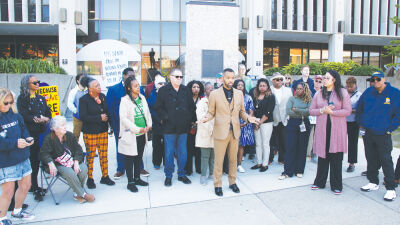
In Macomb County, Black politicians and officials gathered in Mount Clemens on May 21 to raise awareness of how the case could affect politics at home. Assembled beneath the Alexander Macomb statue in the shadow of the 16th Judicial Circuit Court, the rally was opened and led by Macomb County Commissioner Michael Howard, D-Warren.
“We know that when the voter suppression was happening down south, that was not just a southern thing,” Howard said. “So many counties up here also were part of that in restricting or suppressing the voting rights here for Black folks in the north.”
Stacey Derring, an Eastern Michigan University professor of political science, gave a history of the Voting Rights Act of 1965. The act was passed to enforce the 14th and 15th Amendments in the face of restrictions placed on voting — such as poll taxes, literacy tests, property ownership requirements and grandfather clauses — which had an outsized effect on suppressing the votes of Black Americans. The civil rights movement of the 1950s and 1960s raised alarms against these restrictions and faced significant resistance from police, politicians and white supremacist groups, but it was able to influence the passage of several civil rights bills including the 1965 act.
Derring said that while the Supreme Court upheld the act and its sections as constitutional over the years, the court over the past 20 years has whittled away at the Voting Rights Act of 1965. The court’s 2013 decision in Shelby County v. Holder removed the preclearance requirement for voting in certain jurisdictions, as instructed by sections 4 and 5 of the act. In Louisiana v. Callais, decided on April 29, the court deemed majority-minority voting districts as a Section 2 provision unconstitutional.
“(The Callais decision) effectively renders Section 2 dead in most redistricting cases,” Derring said. “It deprives … Black and minority voters of their most powerful federal tool to combat voter dilutions. With the sword and the shield (of the 1965 act) being removed, we are in a severe regressive state of voter protections. Essentially, we’ve reverted back to 1964 and maybe as far back as 1896 when Plessy v. Ferguson was rendered.”
The Callais decision has sparked a flurry of redistricting attempts, particularly in southeastern states where anti-Black voter suppression laws were commonplace prior to the 1965 passing of the Voting Rights Act.
Howard was not afraid of Michigan’s state-level voting districts being affected by the act’s dismantling, since Michigan voting districts are drawn by an independent commission, but the loss of preclearance and minority-majority provisions raised concerns of how local-level districts could be affected. Districts were redrawn twice in Warren ahead of the 2025 elections, which Howard says significantly impacted the districts’ racial makeup. Howard also said accessibility of polls can be targeted by moving voting precincts. Redrawn districts may also lead to nullifying already-cast ballots; in Louisiana, early votes cast for the state’s May 16 House of Representatives primary elections were not counted following the Callais decision.
A fellow Warren politician, City Councilmember Melody Magee, highlighted several “practical” effects of voter suppression in municipal politics.
“(It affects) which neighborhoods get infrastructure repairs,” Magee said. “Which areas get economic investment, how public safety resources are distributed, and which communities get a seat at the table when decisions are made. Voting rights are directly tied to the quality of life in Macomb neighborhoods.
“When voting protections are weakened, it becomes harder for new voices to enter public service and harder for communities to see themselves reflected in our leadership,” Magee said.
Fears about other rights being under attack and restrictions being revived, such as legally enforced racial segregation of marriages, were brought up as well.
Mount Clemens City Commissioner Spencer Calhoun was highly critical of the apparent recent eagerness in state legislatures down south to redraw districts in the wake of Callais and other ongoing acts of voter intimidation.
“There’s no doubt that voting rights are under attack nationwide,” Calhoun said. “States are passing more and more voter suppression laws making it even harder for eligible voters to exercise their right to vote. Even President Trump has gotten involved, calling to nationalize elections, send the military to polling locations and end mail-in voting.”
Speakers at the gathering in Mount Clemens suggested actions their supporters could take going forward. Derring pointed to state-level litigation and voting rights laws as the new battleground for right. Calhoun asked for people to vote in every election they could, attend public meetings and town halls, educate neighbors about redistricting efforts elsewhere, volunteer to be poll watchers and lobby the state Legislature to pass voting rights acts. Rhonda Powell, president of the Metro Equity Collaborative, called on supporters to come together in the fight to retain voting rights.
Attendees heard from Birdie Nash, a woman who lived through the era of Jim Crow discriminatory laws in Alabama. Nash shared, with deep emotion, her experiences growing up with the active threat of the Ku Klux Klan and her family’s experiences being beaten and arrested while taking part in civil rights marches.
“You had to be in the Klan so you could get elected, so the Klan ran everything, and brutality was just… it was just horrific,” Nash said. “I was hoping and praying, and that’s why I work so hard, because I know how bad it can get. We’re not there yet, and that’s why voting is so important and that’s why they are taking it away.”
Howard closed out the event marking June 11 as a day “to begin the conversation (on) where do we go from here.” The date was chosen due to Juneteenth (held on June 19), which commemorates the day that the last slaves were freed in the U.S.
Attendees chanted “We’re not going back” as Howard’s final remarks closed, underscoring the sentiment that the fight for civil rights in the United States was far from over.
“As a young person, it was very easy for me to feel like this fight was over,” Calhoun said. “It had already been fought and won — that’s what I thought. But it’s an absolute shame that not only do young people have to stand up and fight, but those who were part of the original fight have to stand up and pick up right where they left off and get back into this fight for our rights. If our votes didn’t matter, they wouldn’t be fighting tooth and nail to take them from us. So, we need to get up. We need to work together. We need to get engaged and stay engaged in our communities and do everything in our power to protect our neighbors and to protect our voting rights.”
Gus Ghanam, chairman of the Macomb County Republican Party, took issue with claims of voter suppression taking place in Macomb County.
“I can tell you that in Michigan, there’s a lot of ways to vote,” Ghanam said. “We’ve got early voting, in-person voting, absentee voting and there’s more people voting now than ever … They talked about slavery and how they came from the south and there were depressed votes. I don’t believe that should be part of it. If you have a license and you present (it) to get a fishing license, you present your license to go on an airplane, you give your license to go to the doctor’s office. And if you don’t have a license, then you get a state ID. I don’t get where the suppression is coming from.”
Countering the fears of voter suppression possibly happening in Michigan, Ghanam pointed to the Secretary of State’s no-fee ID program, which provides state identification cards to qualifying state citizens at no monetary cost, as one way voting has been made easier in Michigan. Ghanam also highlighted delegate drives as a way the Macomb GOP has worked to get people involved in the political process.
Ghanam expressed concern at a lack of Republican politicians represented at the May 21 event and its primary focus on Black voters.
“I don’t think it’s about minorities voting. It’s about everybody voting,” Ghanam said. “What about the Hispanics? What about the Greeks? What about the Lebanese? What about the Bangladeshis? All those other minorities that they left out … I don’t know where the group was going, other than to say the African American vote has got to come out and vote and I think that’s their message. I know that Detroit has (an) 85% African American voting block down there, so I don’t know where they’re targeting in Michigan here where they think the vote is suppressed.”
Ghanam held up the large number of Black officeholders in Macomb County and the career of John James, a Black Republican representing the 10th District in the House of Representatives and currently running for governor, as counterpoints to claims of voter suppression.
“I don’t know where the suppression is,” Ghanam said. “I think the Democrat party is in chaos and they’re just reaching out, trying to figure out a way to rally the troops. And that’s what they said at the end, to rally the troops so we can vote. But I didn’t see any Republican African Americans there. I mean, there’s a lot of them that are in office, and they didn’t invite them. It was just Democrats. Maybe you have to be a different type of African American to be in the group.”
Ghanam dismissed the claims of voter intimidation as partisan attacks against Trump.
“I think it’s just the Democrats lashing out at the president,” Ghanam said. “The Democrats can’t stand the president. Look at what they’re doing to our country by holding up payment for the TSA workers and the border patrol, just because they hate our president.”
Ghanam does not foresee any voting districts in Macomb County being changed until new census information becomes available and was not aware of any discussions at the county party level of changing maps in light of Callais.
“Whether you vote Democrat or Republican, you have to vote for the candidate,” Ghanam said. “That’s the important part. Whatever their race is, you have to vote for the candidate … I believe that if you’re a good candidate and you have a great platform, people (will not) care what race you are. I think, for the most part, in Alabama and other states down there, they have different problems than we have up here.”