Publication select ▼

CLINTON TOWNSHIP — It was a new venue, old messages and all Paul Gieleghem at the 2025 State of Clinton Township.
The first such address for the Clinton Township treasurer-turned-supervisor since he was elected to the executive position last year, Gieleghem’s speech on the evening of Oct. 23 was a mix of points shared by him over the years, updates about actions in recent months and a list of expected “state-of” highlights. It was a more austere show compared to those in some of the township’s neighboring communities, with Gieleghem flicking between presentation slides. The first major change came in the form of the address’ venue, format and audience.
Gieleghem’s Oct. 23 speech took place in the Clintondale High School auditorium to a small crowd of the general public, held as a free event rather than solely as a fundraiser for the Macomb County Chamber. While the chamber still had its fundraising address the next morning at the Clinton-Macomb Public Library on Canal and Romeo Plank roads, which also featured Gieleghem, the township’s resources were used to document his free address at Clintondale.
“I believe that no one should have to pay to hear their supervisor provide an update on what is happening in their community,” Gieleghem said. “I agreed to do the fundraiser, but first I wanted to deliver it to my community — and I knew where I wanted it to be delivered.”
The issues of public access and expense on the State of the Township came up in 2024 when then-Trustee Mike Keys held a pancake breakfast and food drive for the Vietnam Veterans of America Chapter 154 in protest of township funds being used for a chamber fundraiser. Township communications resources were used for the event among other township funds and resources, and the township board ended up not paying the chamber for the event.
Deputy Supervisor Dan O’Leary, who served under then-Supervisor Robert Cannon as well as Gieleghem, said holding both events allows for two different experiences around the State of Clinton Township.
“The chamber event is a wonderful event, and it is geared more toward public officials, business owners (and) community leaders,” O’Leary said. “Those are usually the ones that go to that sort of thing because it is (first) about what’s going on in the township, but it’s also about intermingling with other officials, other leaders in the community, other businesspeople. It gives you that chance to do that … This is more about helping the people in the community who want to hear more about their government (and) help them know what’s going on. Both serve a purpose, and I think having both of them — it’s a lot more work, I’m not going to lie to you — is a really great idea.”
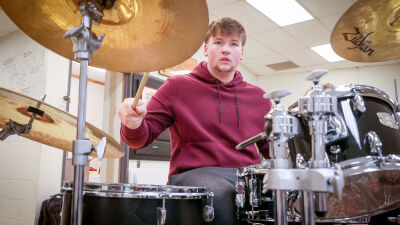
The event on Oct. 23 featured a post-address mixer for members of the public to interact with the township’s department heads and board members, all while getting to have their fill of food prepared by the students of Clintondale’s culinary program.
The choice of going with Clintondale High School not only served as a public venue for the event with in-house catering, but it was as a tangible prop for Gieleghem, a Clintondale alum, who spoke about the township’s status as an inner-ring suburb of southeastern Michigan and the challenges that presents. A bullet point of Gieleghem’s “wide angle lens” approach to viewing the township’s role in the state and region is to “Be Honest With Ourselves,” and it is hard not to view the address as a reckoning with the township’s place in the world.
“From the urban core of Detroit (development) grew in concentric rings, following the major trunklines of Jefferson, Gratiot, Woodward, Grand River, Michigan Avenue and Fort Street … By 1995 the urban area of the region quadrupled in size with most of that growth taking place beyond the limits of the city of Detroit,” Gieleghem said. “It was not more people. It was not more taxpayers. Roughly the same number of people spread out over a wider and wider area. If we dive a little deeper, we see that there is a financial impact to spreading the population out further and further over a larger area. Tax base follows growth, and the receiving communities have a steady stream of new income flooding in as people and businesses turn farm fields into subdivisions until that growth stops. The older communities have older and more costly infrastructure to maintain. People often chase new and bigger, especially if they have the capacity to do so. Businesses then often chase those with more disposable incomes. Older communities pay twice. We pay to repair the aging infrastructure, and we pay to subsidize the new infrastructure.”
Regarding roads, Gieleghem targeted an old bugbear, Public Act 51 of 1951 — the state law governing how road funds are allocated to counties and cities — to illustrate that communities like Macomb Township use the same funding model to maintain or expand two-lane roadways while Clinton Township struggles to maintain four and five-lane roads. For schools, the Chippewa Valley district took on major debt to build schools throughout the growing Macomb Township in the 1990s and 2000s, contributing to an 8.64 mills levy on summer taxes. Clintondale Community Schools, a district in Clinton Township’s older developed south, contributes 13.00 mills to the summer taxes with a declining enrollment rate.
“The people who live in the oldest parts of the community pay the highest school debt on their tax bills,” Gieleghem said. “This is not due to the local government. This is based on the amount of debt the school has from needing to build out or keep pace with technology or they don’t have enough students to spread the cost of all the programs they’re required to provide.”
Regarding roads, Gieleghem touted the efforts of the Establishing Quality Roads Committee to help improve the township’s ability to target in-need roads for repair and track down the funding needed to do that. The committee is responsible as well for a lobbying campaign from township stakeholders, asking residents to send letters advocating changes to the state’s local road funding model.
The costly existence of being an inner-ring suburb has affected the way the government organizes itself. To balance costs while maintaining the level of recreation and senior services in the township, the Recreation Department and Senior Life Center have been merged. Clinton Township has also outsourced high-level emergency management to the county, replacing the dedicated emergency manager role with liaisons to Macomb County Emergency Management and Communications.
Economic development received its time in the sun with Gieleghem praising more experienced-based developments in the township, focusing on the Powerhouse Gym coming to Partridge Creek and the opening of Metro Pickleball. Both projects take a creative approach to utilizing existing commercial space with the Powerhouse Gym filling the lifestyle center’s eastern anchor while Metro Pickleball is built within a former grocery store on Canal and Garfield roads.
Last but not least, Gieleghem highlighted the township’s Board of Trustees and the efforts taken by it in opposition to ITC Transmission’s plan to build power lines near condominiums on 19 Mile Road and holding locally based trash hauler Priority Waste to account for what Gieleghem has characterized as poor service.
You May Also Be Interested In