Publication select ▼

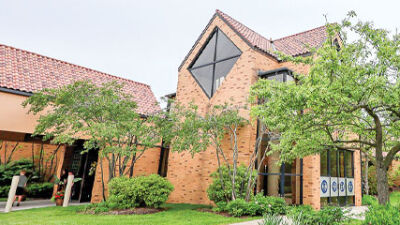
KEEGO HARBOR — On Aug. 7, the Michigan Court of Appeals ruled 3-0 to dissolve an order that had paused the demolition of Roosevelt Elementary. Located in Keego Harbor in the West Bloomfield School District, the school building is more than 100 years old.
WBSD is the defendant in the case. The plaintiff is a grassroots nonprofit called The Heart of the Lakes Community, Inc. Many of its members live and work in Keego Harbor, and own and operate businesses there.
They have been fighting to preserve Roosevelt Elementary, which they see as a historic landmark in Keego Harbor, and part of the town’s identity.
‘Not an easy decision’
Roosevelt Elementary was the oldest operating school in Oakland County from 1920 until it closed in June 2022 after part of a ceiling collapsed in an empty classroom.
Later, it was determined the ceiling had asbestos, according to the court’s written opinion. Students at Roosevelt Elementary were reassigned to other schools in the district.
In September 2023, the school board voted to implement an abatement plan for the asbestos and to have the building demolished. According to school officials, the building was unsafe and maintaining it would be irresponsible to taxpayers.
“This was not an easy decision,” said WBSD Superintendent Dania Bazzi. “It is no longer a safe or viable space for modern learning.”
She said the district remains committed to the students and their futures.
Members of HOTLC have a different view of the situation.
“It’s very disappointing, to say the least. The building is certainly worth saving. It’s a gorgeous building. It’s the center of our town,” said David Emerling, an HOTLC member who lives in Keego Harbor.
“It was decided by 12 people who don’t live in our town and nine people who don’t live in the district,” he said. “They’re making a decision that will destroy history that can’t be recreated.”
The court case
In March 2024, HOTLC amended its complaint in Oakland County Circuit Court to include seven counts against the school board, including alleged violations of the Open Meetings Act and the Freedom of Information Act, among others.
Judges Andrienne Young, Kristina Robinson Garrett and Randy Wallace heard arguments from both sides in the Michigan Court of Appeals on Feb. 5 in Detroit.
“The trial court correctly determined it lacked jurisdiction to invalidate the school board’s Sept. 18, 2023 decision to demolish Roosevelt because the plaintiffs failed to file their lawsuit within the 60-day limitation period,” stated the court.
The plaintiffs attempted to explain the filing delay.
According to Emerling, when the school board ruled to demolish Roosevelt Elementary, the board also stated it would inform HOTLC if any offers were received to purchase the building, at which point there would be further discussion.
“We thought as citizens the decision in September of 2023 was not quite final because they had promised us if offers were coming forward, they would discuss it with us,” Emerling said. “They never did. … When they voted in March 2024 for the companies that would do the demolition and remediation, that’s when we filed.”
Emerling said the chosen contractors were not discussed publicly, but “rubber-stamped” by the board. This complaint was the first count in the case, alleging that the board violated the Open Meetings Act.
The judges disagreed with this conclusion, noting there were different opinions expressed by board members to delay or stop the demolition of Roosevelt Elementary.
“The board approved the lowest bids with a 4-2 vote. Therefore, the board did deliberate on the bids, and did not merely rubber-stamp,” the court stated. “(The board) held a study session and a board meeting at which it heard comments from the public. No evidence indicates that any deliberations or decisions were made behind closed doors.”
The next three counts were also allegations that the board violated the Open Meetings Act, but the judges decided those allegations were unfounded or irrelevant, as well.
Other allegations
The fifth count alleged that the district violated the Freedom of Information Act, or FOIA, by charging an “unreasonable and excessive” fee for records.
Plaintiff Christian Sonneville submitted a FOIA request to the district in January 2024. Sonneville was allegedly told it would cost him nearly $7,800 to copy the materials. He was also reportedly told that the district would need a 50% deposit. As an alternative to copying, he was offered to review the documents in person.
The judges found this allegation irrelevant.
“Count V is unrelated to preventing the demolition of Roosevelt, the purpose for which the plaintiffs sought the preliminary injunction. Therefore, stopping the demolition of Roosevelt during the pendency of this case was unnecessary with respect to a FOIA claim,” the court stated.
The sixth count sought injunctive relief under the Michigan Environmental Protection Agency since the district’s own experts had determined that demolition could pollute the air, causing asbestos exposure above normal levels.
Meanwhile, the seventh count sought a declaratory judgment that demolition without proper asbestos abatement would constitute a negligent nuisance.
The court required the plaintiffs to show evidence supporting these claims that the defendants’ conduct was likely to “pollute, impair or destroy the air, water or other natural resources or the public trust in these resources.”
The judges said the plaintiffs had failed to prove this, and that their claims were speculative.
“The mere apprehension of future injury or damage cannot be the basis for injunctive relief,” the court stated, citing prior case law.
Following the decision, members of HOTLC said the fight is not over. As for the district, officials said no date has been set for the demolition, as of press time.
“We will work with our abatement and demolition contractors to ensure all applicable guidelines are followed,” Bazzi said.
You May Also Be Interested In